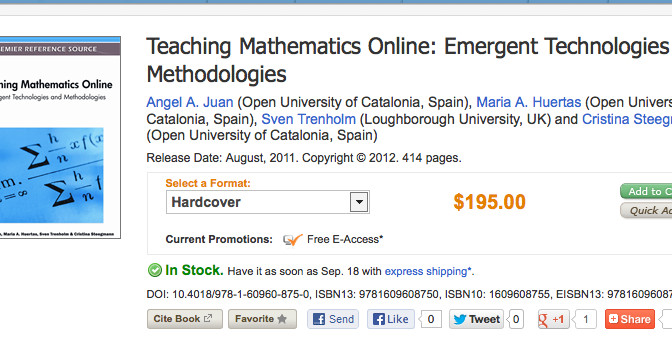
It seems that they sell each section inside of the book separately, with $37.50 per piece. Good idea. Because I AM more interested in some specific sections than others, such as:
Picture retrieved from http://openmatt.org/2011/09/22/whats-your-elevator-pitch-for-badges/
Open Badges and their use for online informal or formal learning have been explored for a while. But it is not easy to hand-bake a badge and issue it manually. I tried to manually create one based on the instruction here: Open Badges: Want to Make Your Own Badges by Hand? Here’s How., but this post doesn’t include the process of Badge issuing and sharing. In general, to issue a Badge to certain learners with the set up of the criteria process of gaining a badge requires quite amount of coding, which is not an easy path. So, it is great news when I found out that Moodle finally released their newest version of Moodle 2.5 as of April 5th, 2013, and that includes the Open Badges function!
So here is the recorded process and tips during the installation of Moodle 2.5 and trying out the Badges function on my GoDaddy server:
Step 1: Download and Upload the Moodle Package
First of all, as of July 25th 2013, GoDaddy does not provide the latest version of Moodle installation. The version they have available right of this time is version 1.9.1. After finding out this, I had to remove the installed moodle and manually downloaded the version 2.5 pack from moodle.org.
Note: as of August 1st 2013, when I checked the latest stable version of Moodle package for download, there was a newer version of Moodle 2.5.1which was made available right after I originally published this blog post. Oh well, this is technology, so we should not be surprised.
Step 2: Create a MySQL database for your moodle site
The next step was to create a MySQL database on your server. Moodle 2.5 requires the MySQL version of 5.5, so be aware of this. I named my database “moodlebadges”.
Step 3: configure your config.php file
After downloading and uploading the package to my server, I started to install it via the website interface. That was when I realized that this version 2.5 does not have the config.php file, which was vital for the installation. Hence I went back to the version 1.9.1 and copied a config.php file and then pasted it into the 2.5 folder.
The next step was to make sure everything inside of that config.php file is correct in terms of your Moodle database connection. This included setting up your database log info, and paths such as your dirroot, dirdoc correctly.
Step 4: Install your moodle site
And now if everything has been set up correctly, you should be able to go to your moodle web address and start installing with the web interface. For my moodle site, the address is blog.tech4teaching.net/moodle
You will first see a screen asking you to choose the language like this (or it could be slightly different depends on your Moodle version):
The next screen is something like this:
Then you will just have to follow the instructions on the screen and finish your installation.
At last, you will see a screen with the Navigation bar and Administration bar on the left, something like this:
Click to expand “Site Administration”, here is the place you set up the site appearance, choose the site theme, turn on/off certain functions.
In my next post, I will talk about how to turn on the Badge function on course level and how to config a course Badge.
Math visualization is vital for students to transform abstract math concepts and to explore math topics. Traditionally math teachers have been using hand-held graphing calculators to help with this type of activities. However, powerful mobile device apps seems to make everything possible. Here we will review several iphone/ipad/android apps that can perform functions that traditional graphing calculators, such as TI-nspire can do, or getting close to them:
Free Graphing Calculator
Typing the keywords of “graphing calculator” in the iPad app store, you will see the first result is Free Graphing Calculator by William Jockusch (as of July 24, 2013):
This app provides a very similar function to some of current hand-held graphing calculators, as shown below. You can tell that this app can do: general calculation, geometry graphing, tables and several shape solvers. It also have in-app references on a number of mathematics topics, such as Algebra, Calculus, Fractions, etc.
Quick Graph
Another free iPad/iPhone app is “Quick Graph“. It provides similar functions although no in-app curriculum related contents.
However, it does have one extra function of 3-D graphing. It is also very easy to save all 2-D, 3-D graphing into jpeg format images for future references.
Mathematics is known to be a beautiful yet very abstract subject. It may be easy for mathematician to visualize complicate equations and functions in their brain, but sometimes can be challenging for students or starters to do this. However, with the advance of computer and graphing technologies. In the following i would like to introduce a few cool tools that are free for math visualization.
The first tool that I like is Wolfgram Alpha. It is a very cool “Computational Knowledge Engine” (that’s what they call themselves). You can type in questions you want to know from basic algebra to a country’s population. Here I typed in the question of “how many people are there in China” since I am from there. They it will search and collect all information about China’s population and then generate charts based on information it collects:
Ok I know, we are talking about MATH visualization. So here it is: if you type in a equation or a problem, Wolfgram gives you the chart based this. For example, typing in: plot r=cos(3*theta/5), you will get this:
Or, it will solve equations for you:
Wolfram Education Portal
Wolfram also provides an educational portal. The portal is currently in Beta version (as of July 2013), and you will need to create an account in order to use it. The content of Wolfram Educational Portal is based on the open book of CK-12 Algebra and it covers but not limited to topics such as equations and functions, real numbers, equations of lines, graphs of equations and functions, solving systems of equations, and polynomials. These contents can be demostrated directly on the Wolfram Educational Portal website. Or teachers can download them to computer and then view them in the Computable Document Format (CDF).
The second interesting online math visulization tool is desmos.com
Having a similar function of Wolfram Alpha, desmos provides on-screen math equation creation “keyboard” for easy creation of equations.
Desmos is great for graphing at the k-12 level because it has sliders, can handle implicit relations, and can handle inequalities. However Desmos can’t handle calculus, which some high school students take.
Desmos allows multiple equations and plots in the same time, therefore students can compare the change of the plots when the factors of the equations change:
Type in an equation, then change the values of each factor, the plot on the right will change:
The exploration function on Desmos allows students to choose a topic on the left and then interact with the graph or modify the expressions:
Lastly, Desmos has a nice gallery of math plots that were saved and shared by its community members, which may be easily adapted to your class:
There are plenty of apps that can support math teaching and learning. Among them, some are for teachers’ general use of creating contents, managing classroom, demonstrating course contents. Some focus more on math content practicing and tutoring. In this section, we will focus on introducing apps that are for students to practice on specific contents. There are many apps for the purpose of students practice and tutoring. Here we will just give several examples and we will only focus on free apps. Therefore, you may want to continue exploring and finding math practice apps that suit for your classroom needs after seeing these examples.
Comprehensive grade levels:
First we will introduce several apps that provides practice and tutoring for multiple grade level and math subjects.
YourTeacher’s Math provides math practices, tutorial videos and audios, self-test, challenge, and extra printable worksheets for grade level from 5 to college. It also has standardized test preparation.
Click the screenshot below for a clearer picture.
MathWay is another comprehensive math practice and tutorial app. It also provides a problem-solving engine, which students can type in a problem and get the restul calculated. MathWay also has an Android version which is available here.
Click the screenshot below for a clearer picture.
Click the screenshot below for a clearer picture.
Math !!! is free to download on iTunes. It provides worksheets for students to practice on problems on topics of Arithmetic, Decimals, Fractions, Percent Ratio & Propotion, Statistics, Geometry, Number Theory, and Algebra. It also has an Live Learning Center, where students can communicate with teachers. Within Math !!!, there are a number of content Apps by grades and areas to purchase.
Click the screenshot below for a clearer picture.
Algebra:
Easel Algebra Pro has a collection of questions for students to practice on topics that are related to algebra. It allows students to droogle on the screen while solving the problem. Students can check answers after they answer the questions. Students can also get help by clicking on the “ShowMe!” button to watch the tutorial videos for each question.
Mangahigh: online free math games for middle school and high school. Teachers can register for free and then upload their students roster. It includes both class challenges and games. For class challenges, it allows you to search by grade level and subject area.
Sumdog: games for grade K-8, for math fact fluency.
Before we start talking about teaching with IWB, it is important to introduce a bit about IWB related software and supporting materials. Interactive Whiteboard companies and many other companies and projects have developed numerous supplemental instructional materials to exploit the interactive features of IWBs. It is these software and supplemental materials that make the teaching with IWBs more meaningful and student-centered. Without these software and materials, IWB “is just a big monitor and mouse.” (Granger, 2008) IWBs allow teachers to demonstrate concepts and ideas in an easy and efficient way.
Since IWBs can be used in so many different ways, it can be used in a variety of ways to assist math teaching and learning. Most commonly, an IWB can be used as a projector and support “Consider” type of math activities. Students can watch information from video clips, animation, presentation or other information displayed on the screen. An IWB can also support a discussion on a topic by connecting to a Classroom Response System (Clicker) and showing the polling results.
Using the interactive features of IWBs, teachers can demonstrate concepts and ideas very easily and efficiently. The following video shows how the teacher can use the Notebook Math tool by Smartboard:
The video below shows how an Algebra teacher wrote a function on the IWB and then the graph of the function showed immediately on the board with the ability of changing the shape of the graph with the change of factors:
Appropriately using IWB can make the “Practice” type activities interactive and interesting with the support of related Software.
For example, SMART Exchange is the community where SMART technologies related resources are shared. Teachers can go to this online community and then search for lessons, manipulatives, question sets, activity packs and gallery collections by grade level and key words. Use the filter on the left side of the screen to narrow down your search results.
IWB is also a very good tool for students to demonstrate their understanding about a math problem solving process.
In addition, IWB can capture your your students’ handwriting. can be seen in many classrooms to be connected to the computer and used as a projector to show the content on the computer.
Edweb.net is one of the most popular online professional learning community for educators. From here you can get yourself connected with teachers in your field from all over the world. You can choose to join communities of your choice based on your interests. In order to see and join these communities, you will need to create a free account first. Some communities related to math education are:
Some communities related to teaching with technologies on edWeb are:
You can also choose to attend numerous of webinar at edWeb for free here. You will also receive email notifications for webinars that are related to the communities that you have joined in.
I am writing a Technology Tool Kit course for middle school and high school math teachers. Before I started writing, I interviewed some math k-6-12 experts and a high school math teacher to get some ideas about what this course should cover. In my conversation with the highs math teacher, she mentioned her school used Clickers last year and people loved it. However, the batteries died and nobody has replaced them. Therefore, the teachers haven’t been able to use these Clickers since the beginning of this year. This is a shame.
I decided to put introduction to both Clickers and its online alternatives to my course. I found it is very good learning method by writing a course – you would think that you know “something”. But you may find yourself not knowing much when you really dig into the topic.
So here is what I found: You have two choices – buying traditional Classroom Response Systems (Clickers), or use their alternatives.
For traditional Clickers, there are a number of major vendors on the market. Almost all of them require a single one-time initial purchase, then registration fee for each semester – please correct me if I am wrong. Some of them actually support the connection to cellphones, tablet, and laptops. One piece of Clicker costs from $20 – $70 dollars, depends on the brand and type you get. You will also have to pay extra for an additional receiver, if your class size exceeds the limitation. Clickers can get lost, broken, or run out of batteries like the high school math teacher said. – I probably am biased, but I don’t like this option.
I explored a few alternative online tools that can achieve the similar functions of Clickers, and I like them.
First of all, for me, Poll Everywhere is the one that requires the minimum of students’ investment. It requires the presenter to have a screen and a projector to project the questions, and then students only need to have to have a cellphone – it doesn’t have to be a Smartphone and it doesn’t have to have web-browsers installed on it.
Some other online tools, such as Socrative, Mentimeter, SoapBox, InfuseLearning, also claim themselves to be able to work with cellphones, laptops and tablets – but these cellphones have to be Smartphones, and will have to have Internet connection and web-browsers on them.
More or less, these online alternative tools support questions types of multiple-choice, short answer(open ended), true/false, rating, ranking. Most of them also support PowerPoint presentation embedding. You will have keep the limitation of voters in mind:
For a Poll Everywhere free account, it is 40 people per poll question; You can choose to pay to upgrade your account in order to overcome this limitation.
For Socrative, it is 50 people per poll question;
Mentimeter claims to have no limitation on the number of voters per question. However, it currently only has multiple-choice question type for free account.
Many of us have met this situation before: you find a wonderful picture from the Internet, and it is perfect for the presentation you are preparing for, or for the online course that you are conducting. However, you couldn’t find any copyright related information from the website where this picture comes from. We are educators, and we care about copyright and intelligence property. What should we do?
One good tip is to use the new feature of Google image search by the actual image.
To do so, you can first go to http://images.google.com/, then click on the camera icon on the right of the search box,
then upload the picture that you have downloaded from the Internet.
Then you hit search.
All places where this image has been used on the Internet will show up in the search results.
From there, you can easily find the original place where this images has been first uploaded and used (usually it is the oldest webpage).
Another suggestion of finding images from the Internet, is to use the “Advanced Search” function of Google Image search.
Once you click on “Advanced search”, it will bring you to a screen with a “usage rights” option at the bottom. Choose “free to use or share” from this option.
Then do search. The results will be all either Creative Commons licensed or Public Domain. I do recommend that you give attribution for either situation.